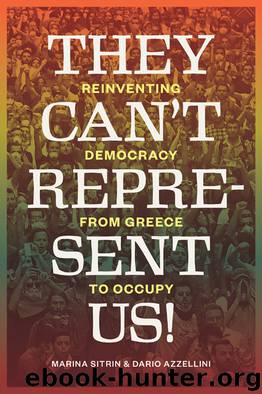
They Can't Represent Us! by Marina Sitrin
Author:Marina Sitrin
Language: eng
Format: epub
Publisher: Verso Books
Published: 2014-06-03T04:00:00+00:00
From mobilization to self-organization
On May 27, 2011 “the Mossos”—the Catalonian police—made a brutal attempt to evict the occupied Plaça de Catalunya, in Barcelona. They used clubs and plastic bullets, causing more than 120 injuries among those in the plaza. Instead of crushing the movement, the state repression had the opposite effect—many more people poured onto the streets and plazas. In many cities, the occupied central plazas functioned as a sort of public arena for citizens’ debates. In Barcelona, and particularly in Madrid, thousands of people gathered in the plazas every day, with the formation of hundreds of working and discussion groups. All of the plazas also saw regular public assemblies, where participants in the movement discussed and made decisions on various issues and actions.
As was true in Greece, a movement for change cannot be confined to a central square. After a few weeks in the plazas, participants in 15-M in the bigger cities began to organize in neighborhoods. The Puerta del Sol encampment was dissolved on June 12 by the full consensus General Assembly of the Plaza—an assembly that lasted all night. The decision was considered both the most likely to produce concrete outcomes, since the movement would be re-territorialized into neighborhoods and other locations, and the most democratic, in the sense that more people could participate. Barcelona and a few other smaller towns retained the plaza encampments for a little longer—and the more general re-territorialization did not entail a distancing from national or regional mobilizations. On June 19, 2011, demonstrations took place in more than eighty Spanish cities. Hundreds of thousands of people took to the streets of Madrid alone to protest the EU’s economic and financial policies.
Just as the media, in 2012, was beginning to declare the movements dead, as they had in the US and other parts of the world—not noticing the neighborhood construction, but only looking to the central plazas—there were again massive mobilizations. On February 19 more than a million people demonstrated in several cities against Rajoy’s austerity program. On July 19, more than 4 million people again protested against the second austerity package of the PP government. Meanwhile the traditional unions also mobilized, and in the fall they called for a general strike. Instead of the movements being “dead,” as so many were claiming, what was in fact happening was that they were reinventing themselves, and growing in depth and breadth—in a process that still continues.
Current mobilizations include the “siege of parliament” of September 25, 2012, as well as various new forms of action. Consistent in these formations is the continued practice within the squares of horizontal relationships, direct action, and self-organization. The pre-existing movement that probably grew most strongly as a consequence of the 15-M was the movement against foreclosure, the Plataforma de Afectedos por la Hipotéca (PAH). It is organized in chapters all over the country, and organizes concrete resistance to foreclosures—a trend that has involved hundreds of thousands of people since the crisis started—and also occupies empty buildings for homeless families.
Download
This site does not store any files on its server. We only index and link to content provided by other sites. Please contact the content providers to delete copyright contents if any and email us, we'll remove relevant links or contents immediately.
| Anthropology | Archaeology |
| Philosophy | Politics & Government |
| Social Sciences | Sociology |
| Women's Studies |
The Secret History by Donna Tartt(18993)
The Social Justice Warrior Handbook by Lisa De Pasquale(12175)
Thirteen Reasons Why by Jay Asher(8870)
This Is How You Lose Her by Junot Diaz(6854)
Weapons of Math Destruction by Cathy O'Neil(6243)
Zero to One by Peter Thiel(5759)
Beartown by Fredrik Backman(5706)
The Myth of the Strong Leader by Archie Brown(5479)
The Fire Next Time by James Baldwin(5407)
How Democracies Die by Steven Levitsky & Daniel Ziblatt(5196)
Promise Me, Dad by Joe Biden(5127)
Stone's Rules by Roger Stone(5065)
A Higher Loyalty: Truth, Lies, and Leadership by James Comey(4937)
100 Deadly Skills by Clint Emerson(4898)
Rise and Kill First by Ronen Bergman(4756)
Secrecy World by Jake Bernstein(4724)
The David Icke Guide to the Global Conspiracy (and how to end it) by David Icke(4676)
The Farm by Tom Rob Smith(4484)
The Doomsday Machine by Daniel Ellsberg(4471)
